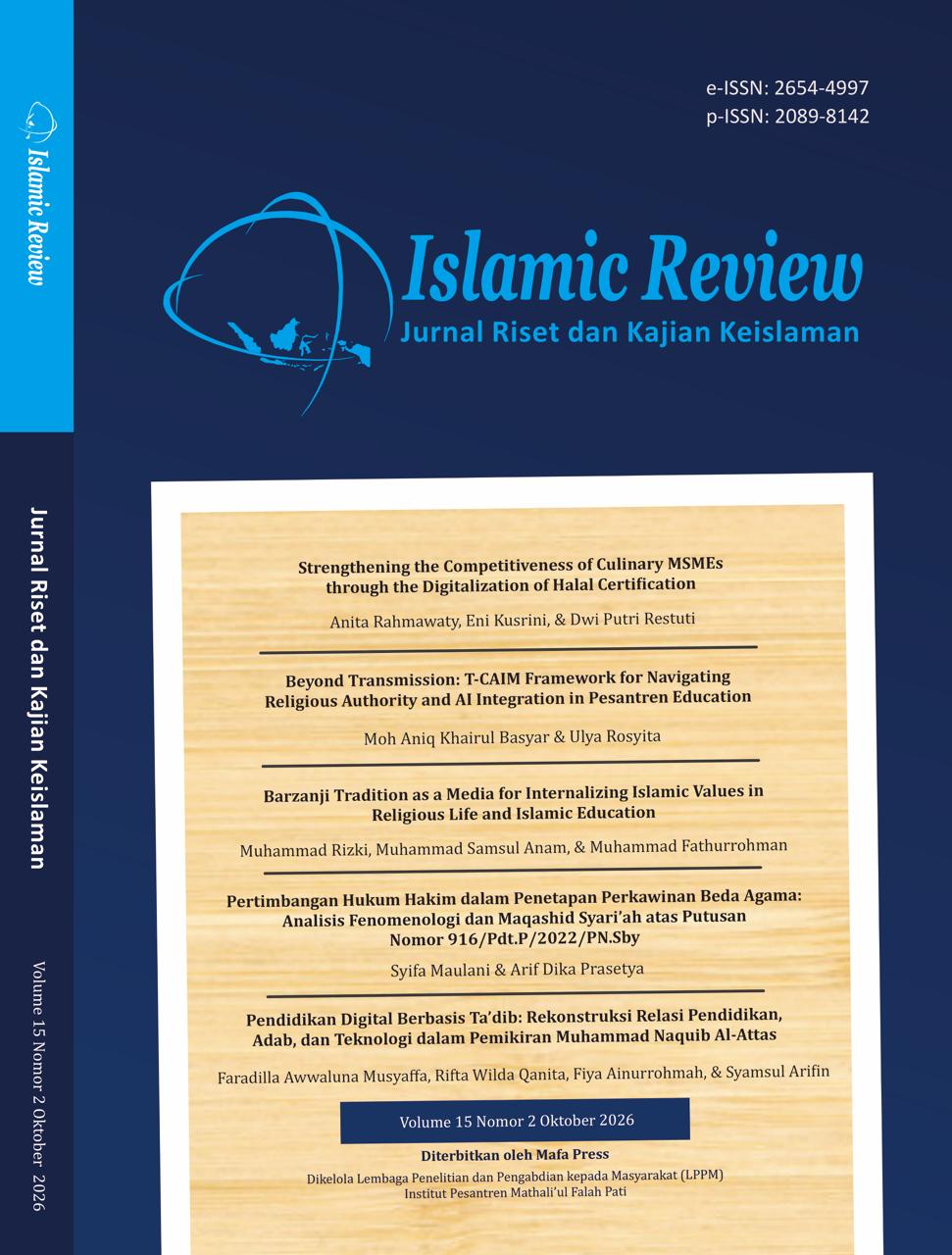
Strengthening the Competitiveness of Culinary MSMEs through the Digitalization of Halal Certification
Abstract
The digitalization of halal certification has become an important strategy for improving the competitiveness of culinary Micro, Small, and Medium Enterprises (MSMEs) amid increasing consumer demand for halal products and digital business transformation. This study aims to examine the role of digital halal certification in strengthening the competitiveness of culinary MSMEs in Demak Regency, Indonesia. A qualitative descriptive approach was employed, using semi-structured interviews, observations, and document analysis. The data were analyzed through data condensation, data display, and conclusion drawing following the interactive analysis model. The findings reveal that digital halal certification enhances consumer trust, strengthens product credibility, simplifies certification procedures, and expands market access through more efficient and transparent digital processes. However, its implementation remains constrained by limited digital literacy, insufficient institutional assistance, and low awareness of the strategic benefits of halal certification among MSMEs. The study highlights that collaboration among government agencies, halal certification authorities, and business support institutions is essential for accelerating digital certification adoption. It concludes that digital halal certification should be viewed not merely as a regulatory requirement but as a strategic capability for improving MSME competitiveness and supporting the development of a sustainable regional halal ecosystem.
Digitalisasi sertifikasi halal menjadi strategi penting dalam meningkatkan daya saing Usaha Mikro, Kecil, dan Menengah (UMKM) kuliner di tengah meningkatnya permintaan produk halal dan transformasi bisnis digital. Penelitian ini bertujuan menganalisis peran digitalisasi sertifikasi halal dalam memperkuat daya saing UMKM kuliner di Kabupaten Demak. Penelitian menggunakan pendekatan deskriptif kualitatif melalui wawancara semi-terstruktur, observasi, dan analisis dokumen. Data dianalisis menggunakan model analisis interaktif melalui kondensasi data, penyajian data, dan penarikan kesimpulan. Hasil penelitian menunjukkan bahwa digitalisasi sertifikasi halal meningkatkan kepercayaan konsumen, memperkuat kredibilitas produk, menyederhanakan proses sertifikasi, serta memperluas akses pasar melalui proses yang lebih efisien dan transparan. Namun, implementasinya masih menghadapi kendala berupa rendahnya literasi digital, terbatasnya pendampingan kelembagaan, dan minimnya pemahaman pelaku UMKM mengenai manfaat strategis sertifikasi halal. Penelitian ini menyimpulkan bahwa digitalisasi sertifikasi halal tidak hanya berfungsi sebagai pemenuhan regulasi, tetapi juga sebagai kapabilitas strategis untuk meningkatkan daya saing UMKM serta mendukung pengembangan ekosistem halal daerah yang berkelanjutan.
Downloads
References
Ali, Afzaal, Guo Xiaoling, Mehkar Sherwani, and Adnan Ali. “Antecedents of Consumers’ Halal Brand Purchase Intention: An Integrated Approach.” Management Decision 56, no. 4 (March 27, 2018): 715–35. https://doi.org/10.1108/MD-11-2016-0785.
Amalia, Riska, Levina Rachmawati Putri, and Maulina Agustin. “Promoting MSME Sustainability: The Role of Halal Certification and E-Commerce.” Journal Business Administration: Entrepreneurship and Creative Industry 5, no. 1 (January 31, 2026): 37–42. https://doi.org/10.32734/jba.v5i1.24608.
Amer, Mahmoud. “Linkage among Halal Quality Standard Certification and SME’s Performance: Palestinian Food Halal Certified SME’s Context.” Arab Gulf Journal of Scientific Research 42, no. 4 (November 28, 2024): 1414–25. https://doi.org/10.1108/AGJSR-03-2023-0109.
Aprilia, Novita, Waspodo Tjipto Subroto, and Norida Canda Sakti. “The Role of Small and Medium Enterprises (SMEs) in Supporting the People’s Economy in Indonesia.” International Journal of Research and Scientific Innovation XI, no. XII (2025): 368–76. https://doi.org/10.51244/IJRSI.2024.11120036.
Ardana, Yudhistira, and Dian Sugiarti. “Indonesia’s Halal Industry: Opportunities, Challenges, and Strategic Directions.” International Journal of Halal Industry 2, no. 1 (May 5, 2026): 77–89. https://doi.org/10.20885/IJHI.vol2.iss1.art5.
Arianty, Erny, Marsono Marsono, Iin Indrawati, and Risnandar Risnandar. “Empowering Sharia-Based MSMEs and Financial Institutions to Enhance the Halal Industry Ecosystem.” Journal of Islamic Economics Lariba 11, no. 1 (June 27, 2025): 297–332. https://doi.org/10.20885/jielariba.vol11.iss1.art12.
Chavarnakul, Thira, Li Da Xu, Zhuming Bi, Achyut Shankar, Gaurav Dhiman, Wattana Viriyasitavat, and Danupol Hoonsopon. “A Systematic Literature Review on Resilient Digital Transformation, Examining How Organizations Sustain Digital Capabilities.” HighTech and Innovation Journal 6, no. 2 (June 1, 2025): 687–722. https://doi.org/10.28991/HIJ-2025-06-02-021.
Creswell, John W. Research Design Pendekatan Metode Kualitatif, Kuantitatif, Dan Campuran. Yogyakarta: Pustaka Pelajar, 2019.
Creswell, John W., and J. David Creswell. Research Design: Qualitative, Quantitative, and Mixed Methods Approaches. London: SAGE Publications, 2017.
Dashti, Laila A.H.F., Tom Jackson, Andrew West, and Lisa Jackson. “Enhancing Halal Food Traceability: A Model for Rebuilding Trust and Integrity in Muslim Countries.” Journal of Islamic Marketing 15, no. 12 (December 2, 2024): 3382–3408. https://doi.org/10.1108/JIMA-06-2023-0167.
Dawes, Sharon S., and Theresa A. Pardo. “Building Collaborative Digital Government Systems,” 259–73, 2002. https://doi.org/10.1007/0-306-47374-7_16.
Dhakirah, Sanita, and Nurul Hidayatinnisa. “Halal Branding, Consumer Trust, and Digital Innovation in the Global Halal Economy.” In Integrating Halal Principles Into Modern Supply Chain Strategies, 245–70. IGI Global Scientific Publishing, 2026. https://doi.org/10.4018/979-8-3373-4197-2.ch008.
Hokmabadi, Hamed, Seyed M. H. S. Rezvani, and Celso Augusto de Matos. “Business Resilience for Small and Medium Enterprises and Startups by Digital Transformation and the Role of Marketing Capabilities—A Systematic Review.” Systems 12, no. 6 (June 20, 2024): 220. https://doi.org/10.3390/systems12060220.
Jailani, Novalini, Rizky Andrean, Khairul Anwar, and Muhammad Ali Gunawan. “MSMEs Market Expansion Strategy: Synergy Of Halal Certification And Digital Marketing.” Tadayun: Jurnal Hukum Ekonomi Syariah 5, no. 2 (December 1, 2024): 163–84. https://doi.org/10.24239/tadayun.v5i2.346.
Jalil, Mohamad Isa Abd, Siti Hajar Samsu, Debrina Puspita Andriani, Shariff Umar Shariff Abd. Kadir, and Habib Ahmed. “Consumer Insights on Halal Certification: Awareness, Perception, and Visibility as Key Determinants of Purchase Behaviour.” Journal of Islamic Monetary Economics and Finance 12, no. 1 (February 26, 2026): 195–228. https://doi.org/10.21098/jimf.v12i1.3086.
Kero, Chalchissa Amentie, and Addisalem Tadesse Bogale. “A Systematic Review of Resource-Based View and Dynamic Capabilities of Firms and Future Research Avenues.” International Journal of Sustainable Development and Planning 18, no. 10 (October 31, 2023): 3137–54. https://doi.org/10.18280/ijsdp.181016.
Lahmar, Arij, and Reema Al Qaruty. “Mitigating Risks in the Halal Supply Chain: A Bibliometric Review of the Role of Technologies.” Journal of Islamic Marketing, April 10, 2026, 1–26. https://doi.org/10.1108/JIMA-07-2025-0412.
Maosul, Asep, Mokhamad Syaom Barliana, A Ana, Sri Subekti, Yulia Rahmawati, and Tati Setiawati. “Gastrodiplomacy as a Cultural Soft Power Strategy: Exploring Indonesian MSME Entrepreneurs’ Perspectives and Vocational Skill Development Needs.” Journal Of Technical Education And Training 18, no. 1 (June 25, 2026). https://doi.org/10.30880/jtet.2026.18.01.003.
Marnita, Marnita. “Directions for the Development of the Halal Ecosystem in Public Policy: A Study of Islamic Law and Legislation in Indonesia.” Al-Ishlah: Jurnal Ilmiah Hukum 27, no. 2 (July 11, 2024): 156–77. https://doi.org/10.56087/aijih.v27i2.477.
Miles, Matthew B., A. Michael Huberman, and Johnny Saldana. Qualitative Data Analysis: A Methods Sourcebook. London: SAGE Publications, 2018.
Nadziroh, Amik, Nirra Fatmah, and Ari Susetiyo. “Challenges in Implementing Character Education through Scouting Extracurricular Activities in Madrasah Ibtidaiyah.” Islamic Review: Jurnal Riset Dan Kajian Keislaman 15, no. 1 (April 30, 2026): 101–14. https://doi.org/10.35878/islamicreview.v15i1.2238.
Nazir, Muhammad. “Technology and Digital Transaction in Halal Retailing.” In Emerging Technology and Crisis Management in The Halal Industry, 123–37. Singapore: Springer Nature Singapore, 2024. https://doi.org/10.1007/978-981-97-1375-2_8.
Nusran, Muhammad, Evriza Noverda Nasution, Mustofa Aji Prayitno, and Eko Sudarmanto. “Halal Certification in The Digital Age: Leveraging Online Platforms for Enhanced Transparency and Accessibility.” Jurnal Ekonomi, Akuntansi Dan Manajemen Indonesia 2, no. 01 (December 16, 2023): 105–15. https://doi.org/10.58471/jeami.v2i01.379.
Procacci, Veronica, Martina Manzo, Tommaso Beck, and Francesco Manca. “Sustainability Certifications as Enablers of Intellectual Capital and Digital Transformation in SMEs.” VINE Journal of Information and Knowledge Management Systems 56, no. 2 (February 3, 2026): 616–36. https://doi.org/10.1108/VJIKMS-07-2025-0304.
Purnomo, Boyke Rudy, Retty Ikawati, and Yuny Erwanto. “Halal Certification Boosts Ratings, Not Sales: Signalling Theory and MSME Modernization in Indonesia’s Digital Food Ecosystem.” British Food Journal 128, no. 7 (June 26, 2026): 2902–21. https://doi.org/10.1108/BFJ-09-2025-1198.
Rahmawaty, Anita. Perilaku Konsmen Dalam Perspektif Islam: Konsep, Teori Dan Analisis. Yogyakarta: Idea Press, 2021.
———. “The Role Of Relationship Marketing And Shariah Compliance On Customers’ Loyalty In Islamic Microfinance.” INFERENSI 10, no. 1 (June 1, 2016): 1. https://doi.org/10.18326/infsl3.v10i1.1-24.
Rahmawaty, Anita, Kharis Fadlullah Hana, Aryanti Muhtar Kusuma, and Anggie Nurulita. “Is Gojek Driveralready Prosperous By Maqasid Syariah?” At-Tijaroh: Jurnal Ilmu Manajemen Dan Bisnis Islam 7, no. 1 (2021). https://doi.org/https://doi.org/10.24952/tijaroh.v6i2.2453.
Rahmawaty, Anita, and Eni Kusrini. Labelisasi Halal Produk UMKM Kuliner. Kudus: CV Kiara Science, 2026.
Rahmawaty, Anita, and Ita Rakhmawati. “Repurchase Intention of Halal Cosmetic Product Among Muslim Consumers: The Roles of Islamic Branding, Halal Awareness, and Trust.” IQTISHADIA 15, no. 1 (July 28, 2022): 1. https://doi.org/10.21043/iqtishadia.v15i1.14668.
Rahwan, Rahwan, Hosaini Hosaini, Muharofah Nur Safitri, and Muzammil Muzammil. “Da’wah Strategy through Islamic Education in the Digital Era.” Islamic Review: Jurnal Riset Dan Kajian Keislaman 15, no. 1 (April 29, 2026): 131–50. https://doi.org/10.35878/islamicreview.v15i1.2213.
Rasyidah, Alvi Nuur, Abdillah Qodri Azizi, and Nur Kholis. “Digital Ecosystems in Supporting Global Trade of Halal Products: Innovation and Challenges.” ADPEBI International Journal of Business and Social Science 5, no. 2 (June 15, 2025): 1–11. https://doi.org/10.54099/aijbs.v5i2.1360.
Razak, Syaparuddin, Syahabuddin Syahabuddin, and Jumriani Raking. “Assessing Social Impact in Halal Business Practices: A Maslahah-Oriented Framework for Sustainable Development.” Journal of Islamic Marketing 17, no. 3 (March 11, 2026): 898–922. https://doi.org/10.1108/JIMA-10-2024-0450.
Ridho, Ahmad. “Integrating Artificial Intelligence and Blockchain to Improve the Accuracy of Halal Certification.” Journal of Halal Review 1, no. 1 (January 25, 2025): 12–22. https://doi.org/10.70764/gdpu-jhr.2025.1(1)-02.
Rohmawati, Wiwin Siti Aminah, and Kamilia Hamidah. “Religious Tolerance Narratives on Social Media: Network Analysis of Indonesian Civil Society Organizations on Instagram (2019–2023).” Islamic Review: Jurnal Riset Dan Kajian Keislaman 14, no. 1 (April 12, 2025): 1–26. https://doi.org/10.35878/islamicreview.v14i1.1517.
Santoso, Lukman, and Abdul Rachman. “Digitalising Halal Certification: The Dynamic of Regulations and Policies Concerning Halal Certification in Indonesia.” Jurisdictie: Jurnal Hukum Dan Syariah 14, no. 2 (January 10, 2024): 265–93. https://doi.org/10.18860/j.v14i2.24115.
Setiawan, Budi, Bambang Pamungkas, Ani Mekaniwati, and Putri Mulya Kusuma. “The Strategic Role of Digital Transformation, Dynamic and Agile Capabilities for the Performance of Micro, Small, and Medium Enterprises (MSMEs).” The Bottom Line 38, no. 2 (June 10, 2025): 130–53. https://doi.org/10.1108/BL-08-2024-0120.
Syarofi, Muhammad, and Nur Syam. “Digital Transformation in Halal Certification: Opportunities for SMEs in Indonesia.” Klabat Journal of Management 6, no. 1 (February 2, 2025): 28. https://doi.org/10.60090/kjm.v6i1.1234.28-39.
Teng, Xiaoyan, Zhong Wu, and Feng Yang. “Impact of the Digital Transformation of Small‐ and Medium‐Sized Listed Companies on Performance: Based on a Cost‐Benefit Analysis Framework.” Edited by Abderrahim Wakif. Journal of Mathematics 2022, no. 1 (January 13, 2022). https://doi.org/10.1155/2022/1504499.
Zeqiri, Jusuf, Kimberly Gleason, Vjollca Visoka Hasani, and Omar Belkhouja. “Religious Affiliation, Halal Labeling and Food Purchase Intention: Evidence from a Desecularizing Society.” Journal of Islamic Marketing, June 16, 2026, 1–28. https://doi.org/10.1108/JIMA-01-2025-0043.

This work is licensed under a Creative Commons Attribution-ShareAlike 4.0 International License.
Pemberitahuan Hak Cipta
Penulis yang menerbitkan bersama Islamic Review: Jurnal Riset dan Kajian Keislaman menyetujui ketentuan berikut:
- Penulis mempertahankan hak cipta dan memberikan jurnal hak publikasi pertama dengan karya yang dilisensikan secara bersamaan di bawah Lisensi Creative Commons Attribution-ShareAlike 4.0 International License (CC BY-SA 4.0) yang memungkinkan orang lain untuk berbagi karya dengan pengakuan kepenulisan karya dan publikasi awal dalam jurnal ini.
- Penulis dapat membuat pengaturan kontrak tambahan yang terpisah untuk distribusi non-eksklusif dari versi jurnal yang diterbitkan dari karya tersebut (misalnya, mempostingnya ke repositori institusi atau menerbitkannya dalam sebuah buku), dengan pengakuan awal publikasi di jurnal ini.
- Penulis diizinkan dan didorong untuk memposting karya mereka secara online (misalnya, di repositori institusional atau di situs web mereka) sebelum dan selama proses pengiriman, karena dapat menghasilkan pertukaran yang produktif, serta kutipan lebih awal dan lebih besar dari karya yang diterbitkan.

Karya ini dilisensikan di bawah Creative Commons Attribution-ShareAlike 4.0 International License.