Pendidikan Digital Berbasis Ta’dib: Rekonstruksi Relasi Pendidikan, Adab, dan Teknologi dalam Pemikiran Muhammad Naquib Al-Attas
Ta'dib-Based Digital Education: Reconstructing the Relationship of Education, Adab, and Technology in the Thought of Muhammad Naquib Al-Attas
Abstract
This study aims to formulate the construction of a ta’dib-based digital education paradigm from the perspective of Syed Muhammad Naquib Al-Attas. The study is grounded in the challenges of digital education, which are not only related to the acceleration of information access and the use of learning technologies, but also to misinformation, the weakening of epistemic authority, declining academic integrity, and the crisis of adab in the use of technology. This research employs a qualitative approach with a library research design. The data were obtained from Al-Attas’s works and scholarly literature relevant to ta’dib, Islamic education, digital literacy, and technological ethics. The data were analyzed using content analysis with a descriptive-analytical approach. The findings show that ta’dib serves as the philosophical foundation of Islamic education by integrating knowledge, adab, and action in shaping civilized human beings. In the context of digital education, ta’dib functions as a normative-philosophical framework for reorganizing the relationship between human beings, knowledge, and technology. This paradigm positions technology as a wasilah, not a ghayah, and emphasizes adab-based digital literacy, the strengthening of epistemic authority, value-based learning, holistic assessment, and ethical technology governance. Thus, a ta’dib-based digital education paradigm can serve as an integrative framework for Islamic education that remains adaptive to technological development without losing its value orientation, adab, and educational objectives.
Downloads
References
Abdul‑Jabbar, Wisam Kh. “Resisting AI Over-Reliance through the Pedagogy of Al-Ta’dib التأديب.” Interculturality (2025).
Ahmed, Farah. “An Exploration of Naquib Al-Attas’ Theory of Islamic Education as Ta’dīb as an ‘Indigenous’ Educational Philosophy.” Educational Philosophy and Theory 50, no. 8 (July 2018): 786–794.
Al-Attas. Islam And Secularism. IKIM, 2014.
———. The Concept of Education in Islam: A Framework for an Islamic Philosophy of Education. International Institute of Islamic Thought and Civilization, 1991.
———. “Prolegomena to the Metaphysics of Islām: An Exposition of the Fundamental Elements of the Worldview of Islām,” 1995.
———. “Risalah Untuk Kaum Muslimin.” ISTAC, 2001.
Archambault, Susan Gardner, Shalini Ramachandran, Elisa Acosta, and Sheree Fu. “Ethical Dimensions of Algorithmic Literacy for College Students: Case Studies and Cross-Disciplinary Connections.” The Journal of Academic Librarianship 50, no. 3 (2024): 102865.
Bagheri Noaparast, Khosrow. “Al-Attas Revisited on the Islamic Understanding of Education.” Journal of Shi’a Islamic Studies 5 (March 2012): 149–172.
Barratun Naqiyah, and Ayu Handayani. “The Concept of Adab and Ta’dib in Islamic Education: Its Relevance to Character Education in the Digital Age .” Jurnal Pendidikan Guru Madrasah Ibtidaiyah Al-Amin 3, no. 1 SE-Articles (April 2024): 151–168.
Bowen, Glenn A. “Document Analysis as a Qualitative Research Method.” Qualitative Research Journal 9, no. 2 (August 2009): 27–40.
Çiftçi, Muhammed. “Spirituality and Giftedness: A Brief Review.” International Journal of Children’s Spirituality 30, no. 3–4 (2025): 231–240.
Cohn, Jenae. “‘Devilish Smartphones’ and the ‘Stone-Cold’ Internet: Implications of the Technology Addiction Trope in College Student Digital Literacy Narratives.” Computers and Composition 42 (2016): 80–94.
Day, Michael James. “Conclusion: Emancipatory Education Without Boundaries in the Age of Neoliberalism, Artificial Intelligence, and Digital Learning Platforms BT - Emancipatory Education Without Boundaries in the Age of Neoliberalism, Artificial Intelligence and Digital Learning Platforms.” edited by Michael James Day, 313–318. Cham: Springer Nature Switzerland, 2025.
Deena, G., and K. Raja. “Designing an Automated Intelligent E-Learning System to Enhance the Knowledge Using Machine Learning Techniques.” International Journal of Advanced Computer Science and Applications 10, no. 12 (2019): 112–119.
Dolničar, Danica, and Bojana Boh Podgornik. “Undergraduate Students’ Information Literacy in Relation to Their ICT Proficiency and Psychological Characteristics.” 290–303, 2024.
Effendi, Zulham. “Pemikiran Pendidikan Muhammad Naquib Al-Attas.” WARAQAT : Jurnal Ilmu-Ilmu Keislaman 2 (September 2020): 14.
Eke, Damian Okaibedi. “ChatGPT and the Rise of Generative AI: Threat to Academic Integrity?” Journal of Responsible Technology 13 (2023): 100060.
Feijoo, Beatriz, Patricia Núñez-Gómez, and Erika P Álvarez-Flores. “La Alfabetización Publicitaria de Niños y Adolescentes Ante Los Nuevos Formatos Digitales.” index.comunicación 15, no. 1 SE-Monográfico 15(1) Alfabetización publicitaria de niños y adolescentes (January 2025): 13–29.
Fisher, Matthew, Adam H Smiley, and Tito L H Grillo. “Information without Knowledge: The Effects of Internet Search on Learning.” Memory (Hove, England) 30, no. 4 (April 2022): 375–387.
Fleckenstein, Johanna, Jennifer Meyer, Thorben Jansen, Stefan D Keller, Olaf Köller, and Jens Möller. “Do Teachers Spot AI? Evaluating the Detectability of AI-Generated Texts among Student Essays.” Computers and Education: Artificial Intelligence 6 (2024): 100209.
Fu, Ying, and Thosporn Sangsawang. “The Impact of Artificial Intelligence–Driven Social Media on Educational Opportunities and Curriculum Effectiveness in Higher Education.” Studies in Media and Communication; Vol 14, No 3 (2026): [In Progress]DO - 10.11114/smc.v14i3.8625 (March 2026).
Ghozil, Agung, Rifkiya, and Arawinda. “Transformation Of 2013 Curriculum To Merdeka Curriculum In Islamic Religious Education At Vocational Schools.” Jurnal Pendidikan Agama Islam 11, no. 2 (2025).
Giménez, Pilar. “Returning to the Essentials: Ethics, Humanism, and Responsibility in University Education.” Analele Universităţii din Craiova. Seria Filosofie 55, no. 1 (2025): 191–216.
Haramain, Muhammad. Metodologi Penelitian Kepustakaan (Literature Review). Edited by Syaifullah. 1st ed. Parepare: IAIN Parepare Nusantara Press, 2023.
Hidayatullah, Elit Ave, and Syamsuddin Arif. “Syed Muhammad Naquib Al-Attas’ Exposition On The Concept Of Ethics.” Afkar 24, no. 1 (2022): 409–446.
Hikam, Thalib, Luthfi, Ahmad, and Dulanam. “Reconstructing The Essence Of Methods, Tools, And Media In Islamic Education In The Digital Era: A Ta’dib And Spiritual Education Perspective.” Atta’dib: Jurnal Pendidikan Agama Islam 7, no. 1 (2026).
Holmes, Wayne, Kaska Porayska-Pomsta, Ken Holstein, Emma Sutherland, Toby Baker, Simon Buckingham Shum, Olga C Santos, et al. “Ethics of AI in Education: Towards a Community-Wide Framework.” International Journal of Artificial Intelligence in Education 32, no. 3 (2022): 504–526.
Hort, Mikhail G. “Knowledge Transfer, Not Just True Beliefs: Virtue Epistemology as a Philosophical Basis for Education.” International Scientific Electronic Journal 70, no. 4 (2024): 10–24.
Hsieh, Hsiu-Fang, and Sarah E. Shannon. “Three Approaches to Qualitative Content Analysis.” Qualitative Health Research 15, no. 9 (November 2005): 1277–1288.
Husna, Jami’atul, Sekar Ardhanun, and Abdurrahmansyah. “Adab Sebagai Fondasi Ilmu: Perspektif Syed Muhammad Naquid Al-Attas Terhadap Krisis Pendidikan Modern.” Jurnal Ilmiah Pendidikan Dasar 10, no. 04 (2025).
In’ami, Moh, Bambang, and Ismail Suardi Wekke. “Contextualising Adab in Islamic Education from the Perspective of Al-Attas.” Journal of Al-Tamaddun 20, no. 1 (2025): 145–158.
Korobkina, Tetiana, Natalia Dashenkova, Olha Myttseva, Olena Bakalenko, and Viktoriia Omelchenko. Education Without a Face in the Age of Existential Deficit : How Globalization , Post-Truth , and the Politics of Meaninglessness Dehumanize Pedagogy CHAPTER 3 CHAPTER 3, 2025.
Kosim, Muhammad, Martin Kustati, and Murkilim. “Syed Muhammad Naquib Al-Attas’ Ideas on the Islamization of Knowledge and Its Relevance with Islamic Education in Indonesia.” MIQOT: Jurnal Ilmu-Ilmu Keislaman 44, no. 2 (2020): 250–267.
Kotikalapudi, Kalpana Bharathi, and Sambhani Naga Gayatri. “Artificial Intelligence in Education an Educational Perspective on Personalization Equity and Ethics.” Discover Education 5, no. 1 (2026): 187.
Kumar, A, and S Srivastava. “The Analysis of AI Based Algorithms in Personalized and Adaptive E-Learning Experiences.” In 2024 International Conference on IoT, Communication and Automation Technology (ICICAT), 11–16, 2024.
Lesková, Andrea, Zuzana Uličná, Hedviga Tkáčová, Klodiana Leka, and Daniel Alvarez Mateo. “Challenges and Current Issues of Education in the Era of Digital and Technological Changes.” Journal of Education Culture and Society 14, no. 2 SE-DYNAMICS (September 2023): 319–327.
Li, Alice, and Luanne Sinnamon. “Generative AI Search Engines as Arbiters of Public Knowledge: An Audit of Bias and Authority.” Proceedings of the Association for Information Science and Technology 61, no. 1 (October 2024): 205–217.
Lütge, Christoph, Alexander Kriebitz, Raphael Max, and Caitlin C Corrigan. Chapter 8: Ethical Issues in Mobility and Transportation through Autonomous Technologies: From Sea and Land, to Air and Space. Cheltenham, UK: Edward Elgar Publishing, 2024.
Maharani, Chika, Devi Amelia Ningrum, Aulia Eka Fatmawati, and Arif Fadilla. “Dampak Kemiskinan Terhadap Kualitas Pendidikan Anak Di Indonesia: Rekomendasi Kebijakan Yang Efektif.” Journal of Macroeconomics and Social Development 1, no. 3 (2024): 1–10.
Mohamed, Alwy, M Rozaq, Muhammad Ndow, and Mohd Rabe. “Adab as the Epistemological Foundation of Islamic Education: A Study of Syed Naquib Al-Attas” (January 2025): 47–62.
Mush’ab, Fauzan, and Zamzami. “The Relevance of Contemporary Islamic Education in the Thought of Syed Muhammad Naquib Al-Attas.” Jurnal Inovasi Pendidikan 12, no. 1 (2026).
Nurhasanah, Suralaga, Rosyidah, Nihayah, Fitri, Solihat, and Ernada. “Evaluating ChatGPT’s Accuracy Across Cognitive Levels in Academic Assessments.” TARBIYA: Journal of Education in Muslim Society 11, no. 2 SE-Articles (2024): 211–224.
Pangastuti, Ratna, H M Suyudi, Machfudz Bahtiar, Nasrul Fuad Erfansyah, and Zaini Abdullah. “Education Management Strategies for Internalizing Moderate Religious Values in Learning Quran, Hadith, and Aqeedah Akhlaq in Madrasah Ibtidaiyah.” Munaddhomah: Jurnal Manajemen Pendidikan Islam 6, no. 1 SE-Articles (February 2025): 1–12.
Parasnis, Eesha. “The Implications of Social Media For Adolescent Critical Thinking From an Information and Advertising Literacy Context: A Brief Review.” The Serials Librarian 83, no. 1 (July 2022): 9–15.
Popenici, Stefan A D, and Sharon Kerr. “Exploring the Impact of Artificial Intelligence on Teaching and Learning in Higher Education.” Research and Practice in Technology Enhanced Learning 12, no. 1 (2017): 22.
Potiua, and Anuli. “The Effect of Ethical Digital Governance Based Educational Management on the Managerial Readiness of Madrasah Ibtidaiyah Teachers.” Jurnal Prima Edukasia 14, no. 2 (2026).
Putra, Mawazi, and Hifza. “Analysis of Adab Education According to Syed Muhammad Naquib Al-Attas.” International Research-Based Education Journal 5, no. 01 (2023).
Rajput, Dr. “Values-Based Education in the Age of Digital Transformation.” 237–262, 2025.
Samhudi, Samhudi, Saifullah Idris, and Al Husaini M Daud. “The Concept of Ta’dib According To Syed Muhammad Naquib Al-Attas and Its Relevance to Contemporary Islamic Education.” Jurnal Pendidikan Islam 06, no. 02 (2025).
Sassi, Komaruddin. “Prinsip-Prinsip Epistemologi Pendidikan Islam Paradigma Tauhid Naquib Al-Attas.” Millah: Journal of Religious Studies 20, no. 1 SE-Islamic education (September 2020): 135–172.
Sassi, Komarudin. “Principles of Islamic Education Epistemology Tauhid Paradigm (Analysis of Thinking of Naquib Al-Attas).” International Journal of Elementary Education 10, no. 3 (August 2021): 68–78.
———. “Ta’dib As A Concept Of Islamic Education Purification: Study On The Thoughts Of Syed Muhammad Naquib Al-Attas.” Journal of Malay Islamic Studies 2 (November 2018): 1–14.
Seghid, Niyat, Farkhund Iqbal, and Khalifa Al-room. “Emerging Threats in AI : A Detailed Review of Misuses and Risks across Modern AI Technologies.” Front. Commun. Netw, no. February (2026): 1–19.
Simpson, Thomas W. “Evaluating Google as an Epistemic Tool.” Metaphilosophy 43, no. 4 (July 2012): 426–445.
Suarta, I Made, Nyoman Sentosa Hardika, I Gusti Ngurah Sanjaya, and I Wayan Basi Arjana. “Model Authentic Self-Assessment Dalam Pengembangan Employability Skills Mahasiswa Pendidikan Tinggi Vokasi.” Jurnal Penelitian dan Evaluasi Pendidikan 19, no. 1 (June 2015): 46–57.
Sumanta. “The Values of Perfect Human Beings in the Dignity Seven of Insān Kāmil.” Journal of Social Studies Education Research 12, no. 4 (2021): 286–301.
Tkácová, Hedviga. “Challenges of Misinformation in Online Learning: A Post-Pandemic Perspective.” Encyclopedia, 2025.
Tong, Yu, Judith H Danovitch, Fuxing Wang, and Weijun Wang. “Children Weigh Internet Inaccuracy When Trusting in Online Information.” Journal of Experimental Child Psychology 249 (2025): 106105.
Toyooka, Seikai, R Kyle Martin, Lars Engebretsen, and Gilbert Moatshe. “Potential Risks and Ethical Issues with Intelligent Technologies in Orthopedics BT - Artificial Intelligence in Orthopaedic Surgery Made Easy.” edited by Filippo Familiari, Olimpio Galasso, and Giorgio Gasparini, 205–211. Cham: Springer Nature Switzerland, 2024.
Vodičar, Janez. “Authority in Education and Religion in the Digital Age.” Bogoslovni Vestnik 83, no. 4 (2023): 1035–1047.
Wangid, Muhammad Nur, Ali Mustadi, Anwar Senen, and Nur Luthfi Rizqa Herianingtyas. “The Evaluation of Authentic Assessment Implementation of Curriculum 2013 in Elementary School.” Jurnal Penelitian dan Evaluasi Pendidikan 21, no. 1 (June 2017): 104–115.
Warisno, Andi, Muhammad Afif Anshori, and Nur Hidayah. “Islamic Education Management, Sufism, and Digital Literacy: An Interdisciplinary Approach.” Qubahan Academic Journal 6, no. 1 (January 2026): 257–271.
Wiratama, Andi. “Konsep Pendidikan Islam Dan Tantangannya Menurut Syed Muhammad Naquib Al-Attas.” At-Ta’dib 5 (June 2011).
Wu, Yue, Beatrix Fregan, Zoltan Rajnai, and Balint Bordacs. Advancing Accessibility, Engagement, and Innovation through Digital Education Technologies: A Comprehensive Analysis, 2025.
Yunita, Ita, Anis Saidah, and Muhammad Fahmi. “The Imperative of Integrating Knowledge and Adab in Reconstructing Islamic Education in the Digital Era: A Study of Al-Attas’s Thought.” J-PAI: Jurnal Pendidikan Agama Islam 11 (May 2025).
Zou, Yumei, Florence Kuek, Wenqin Feng, and Xiaoli Cheng. “Digital Learning in the 21st Century: Trends, Challenges, and Innovations in Technology Integration.” Frontiers in Education Volume 10 (2025).
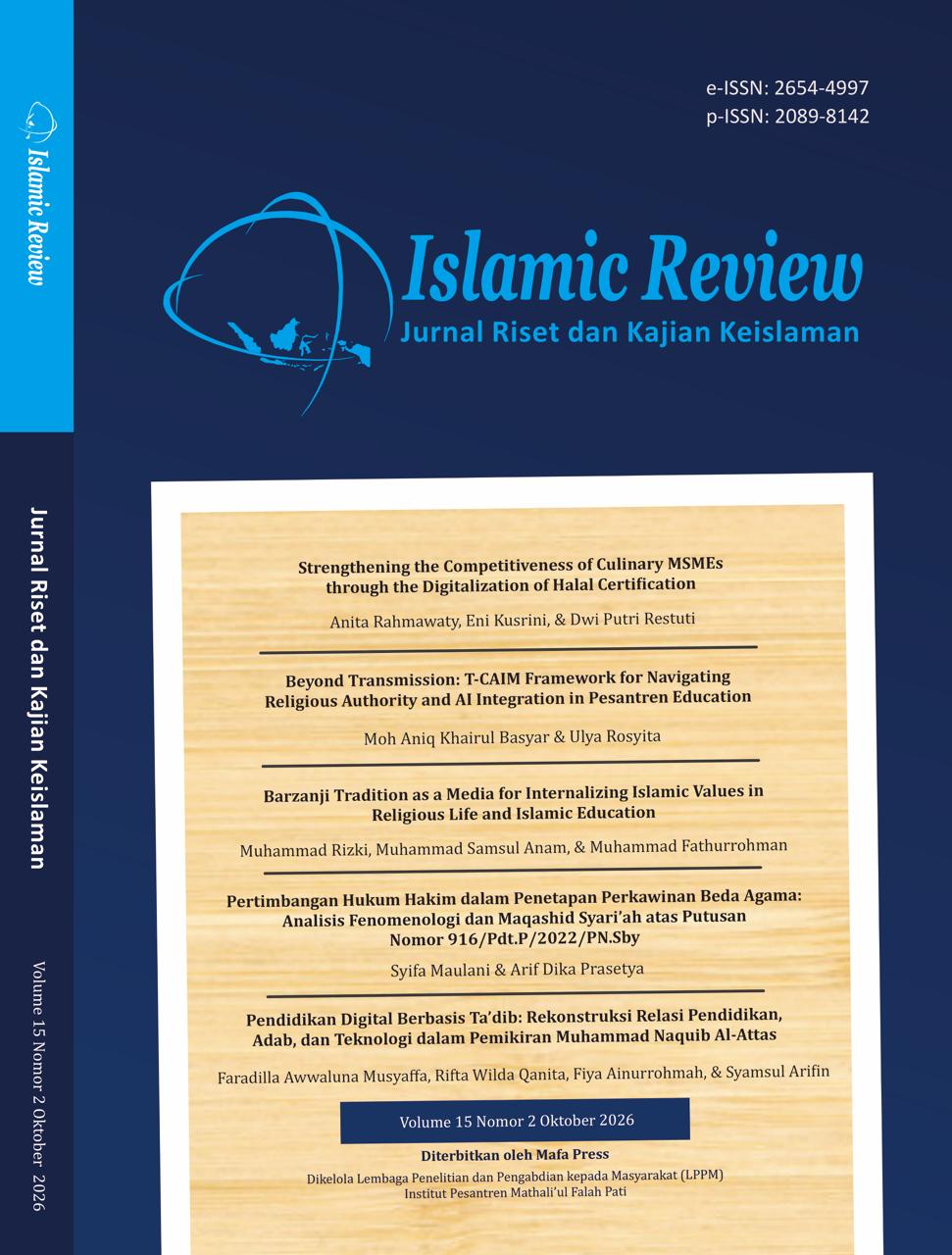

This work is licensed under a Creative Commons Attribution-ShareAlike 4.0 International License.
Pemberitahuan Hak Cipta
Penulis yang menerbitkan bersama Islamic Review: Jurnal Riset dan Kajian Keislaman menyetujui ketentuan berikut:
- Penulis mempertahankan hak cipta dan memberikan jurnal hak publikasi pertama dengan karya yang dilisensikan secara bersamaan di bawah Lisensi Creative Commons Attribution-ShareAlike 4.0 International License (CC BY-SA 4.0) yang memungkinkan orang lain untuk berbagi karya dengan pengakuan kepenulisan karya dan publikasi awal dalam jurnal ini.
- Penulis dapat membuat pengaturan kontrak tambahan yang terpisah untuk distribusi non-eksklusif dari versi jurnal yang diterbitkan dari karya tersebut (misalnya, mempostingnya ke repositori institusi atau menerbitkannya dalam sebuah buku), dengan pengakuan awal publikasi di jurnal ini.
- Penulis diizinkan dan didorong untuk memposting karya mereka secara online (misalnya, di repositori institusional atau di situs web mereka) sebelum dan selama proses pengiriman, karena dapat menghasilkan pertukaran yang produktif, serta kutipan lebih awal dan lebih besar dari karya yang diterbitkan.

Karya ini dilisensikan di bawah Creative Commons Attribution-ShareAlike 4.0 International License.